Posts

Showing posts with the label Plants

The Cultivation of Aquatic Plants - What You Need to Know

Image
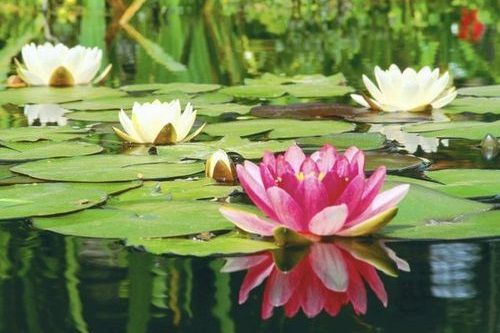
When raising aquatic plants in outdoor ponds, it is important to consider the amount of light available, the depth of the pond, the kind of soil, and various other factors. Since most aquatic plants obtain nourishment from the soil, it is necessary to have a soil rich in organic matter. In most natural ponds the accumulation of humus at the bottom is excellent for plant growth. In some ponds, however, the bottom consists largely of sand or gravel that must be covered with a thick layer of rich soil. If the pond is very large, it is often easier to root the plants in earth-filled boxes or pots than to place a thick layer of soil over the entire bottom of the pond. Most aquatic plants require large amounts of light and should not be grown in shaded areas. In some regions, it is also important to protect the plants from strong winds by growing shrubbery or other windbreaks near the edge of the pond. The depth of the water should be determined by the size of the plants. In many cases,...
4 Major Groups of Aquatic Plants

Image
Aquatic Plants are plants that grow in water. Such plants occur in almost every major group of the plant kingdom and are widely distributed throughout the world, inhabiting oceans and brackish lakes as well as freshwater lakes, rivers, and streams. Although most aquatic plants live only in water, some species may also live on land. In these species, however, the land-dwelling form often differs in appearance from the aquatic form. The aquatic arrowhead, for example, has limp, ribbonlike leaves, while the terrestrial form bears the stiff, arrowhead-shaped leaves from which the plant's name is derived. Major Groups Aquatic plants are generally divided into four major groups. Plants of the first group float freely on or below the surface of the water and have no connection with the soil. Among the best known of these plants is the salvinia, a small ornamental plant with whorls of oval leaves that are covered with stiff, bristly hairs on their upper surface. The salvinia is grown ...

Paleoclimatology: A Window to Past and Future

Paleoclimatology, the study of past climate patterns, is urgently being pursued in order to unravel the mysteries of current climate upheavals, such as droughts, floods, and global warming. Instrumental temperature records do not go back beyond the mid-1800s, but paleoclimatologists can investigate climate changes over past decades, centuries, and millennia. Through the study of tree rings, coral reefs, ice cores, and sediments in lakes and oceans, paleoclimatologists can help to determine what amount of climate variability is normal or natural for the earth.

Orchids: Nature's Con Artists and Codependents

Orchids are arguably the largest family of plants. Examples of the family Orchidaceae appear in virtually every climate on six continents. Yet, for all their survival prowess, orchids have proven for centuries to be among the most challenging flowers for botanists to cultivate. Moreover, even in the wild, orchids rely on a dazzling array of unique and specialized pollination strategies by which to reproduce. These ploys place many types of orchids at the mercy of a single partner species of insect.